Social Media Buttons - Click to Share this Page


06 October, 2020

THE LIFE OF DAVID ACCORDING TO THE PSALMS—CONTINUED—XV. THE SONGS OF THE FUGITIVE 1/5


The psalms which probably belong to the period of Absalom's rebellion correspond well with the impression of his spirit gathered from the historical books. Confidence in God, submission to His will, are strongly expressed in them, and we may almost discern a progress in the former respect as the rebellion grows. They flame brighter and brighter in the deepening darkness. From the lowest abyss the stars are seen most clearly. He is far more buoyant when he is an exile once more in the wilderness, and when the masks of plot and trickery are fallen, and the danger stands clear before him. Like some good ship issuing from the shelter of the pier heads, the first blow of the waves throws her over on her side and makes her quiver like a living thing recoiling from a terror, but she rises above the tossing surges and keeps her course. We may allocate with a fair amount of likelihood the following psalms to this period—iii.; iv.; xxv. (?); xxviii. (?); lviii. (?); lxi.; lxii.; lxiii.; cix. (?); cxliii.

The first two of these form a pair; they are a morning and an evening hymn. The little band are encamped on their road to Mahanaim, with no roof but the stars, and no walls but the arm of God. In the former the discrowned king sings, as he rises from his nightly bivouac. He pours out first his plaint of the foes, who are described as "many," and as saying that, "There is no help for him in God," words which fully correspond to the formidable dimensions of the revolt, and to the belief which actuated the conspirators, and had appeared as possible even to himself, that his sin had turned away the aid of heaven from his cause. To such utterances of malice and confident hatred he opposes the conviction which had again filled his soul, that even in the midst of real peril and the shock of battle Jehovah is his "shield." With bowed and covered head he had fled from Jerusalem, but "Thou art the lifter up of mine head." He was an exile from the tabernacle on Zion, and he had sent back the ark to its rest; but though he has to cry to God from beyond Jordan, He answers "from His holy hill."He and his men camped amidst dangers, but one unslumbering Helper mounted guard over their undefended slumbers. "I laid me down and slept" there among the echoes of the hills. "I awaked, for Jehovah sustained me;" and another night has passed without the sudden shout of the rebels breaking the silence, or the gleam of their swords in the starlight. The experience of protection thus far heartens him to front even the threatening circle of his foes around him, whom it is his pain to think of as "the people" of God, and yet as his foes. And then he betakes himself in renewed energy of faith to his one weapon of prayer, and even before the battle sees the victory, and the Divine power fracturing the jaws and breaking the teeth of the wild beasts who hunt him. But his last thought is not of retribution nor of fear; for himself he rises to the height of serene trust, "Salvation is of the Lord;" and for his foes and for all the nation that had risen against him his thoughts are worthy of a true king, freed from all personal animosity, and his words are a prayer conceived in the spirit of Him whose dying breath was intercession for His rebellious subjects who crucified their King, "Thy blessing be upon Thy people."


04 October, 2020

THE LIFE OF DAVID ACCORDING TO THE PSALMS—CONTINUED XIV.—CHASTISEMENTS 3/3


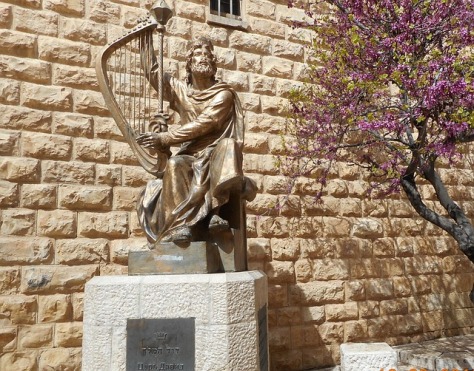
This image has an empty alt attribute; its file name is jerusalem-2353514_640.jpg

Violence and Strife in possession of it, spies prowling about the walls day and night, Evil and Trouble in its midst, and Destruction, Oppression, and Deceit—a goodly company—flaunting in its open spaces. And the spirit, the brain of the whole, is the trusted friend whom he had made his own equal, who had shared his secretest thoughts in private, who had walked next him in solemn processions to the temple. Seeing all this, what does the king do, who was once so fertile in resource, so decisive in counsel, so prompt in action? Nothing. His only weapon is prayer. "As for me, I will call upon God; and the Lord will save me. Evening, and morning, and at noon, will I pray, and cry aloud: and He shall hear my voice." He lets it all grow as it list, and only longs to be out of all the weary coil of troubles. "Oh that I had wings like a dove, then would I fly away and be at rest. Lo, I would flee far off, I would lodge in the wilderness. I would swiftly fly to my refuge from the raging wind, from the tempest." The langour of his disease, love for his worthless son, consciousness of sin, and submission to the chastisement through "one of his own house," which Nathan had foretold, kept him quiet, though he saw the plot winding its meshes round him. And in this submission patient confidence is not wanting, though subdued and saddened, which finds expression in the last words of this psalm of the heavy laden, "Cast thy burden upon Jehovah. He, He will sustain thee.... I will trust in Thee."

When the blow at last fell, the same passive acquiescence in what he felt to be God's chastisement is very noticeable. Absalom escapes to Hebron, and sets up the standard of revolt. When the news comes to Jerusalem the king's only thought is immediate flight. He is almost cowardly in his eagerness to escape, and is prepared to give up everything without a blow. It seems as if only a touch was needed to overthrow his throne. He hurries on the preparations for flight with nervous haste. He forms no plans beyond those of his earlier wish to fly away and be at rest. He tries to denude himself of followers. When the six hundred men of Gath—who had been with him ever since his early days in Philistia, and had grown grey in his service—make themselves the van of his little army, he urges the heroic Ittai, their leader, to leave him a fugitive, and to worship the rising sun, "Return to thy place, and abide with the king"—so thoroughly does he regard the crown as passed already from his brows. The priests with the ark are sent back; he is not worthy to have the symbol of the Divine presence identified with his doubtful cause, and is prepared to submit without a murmur if God "thus say, I have no delight in thee."

With covered head and naked feet he goes up the slope of Olivet, and turning perhaps at that same bend in the rocky mountain path where the true King, coming to the city, wept as he saw its shining walls and soaring pinnacles across the narrow valley, the discrowned king and all his followers broke into passionate weeping as they gazed their last on the lost capital, and then with choking sobs rounded the shoulder of the hill and set their faces to their forlorn flight. Passing through the territory of Saul's tribe—dangerous ground for him to tread—the rank hatred of Shimei's heart blossoms into speech. With Eastern vehemence, he curses and flings stones and dust in the transports of his fury, stumbling along among the rocks high up on the side of the glen, as he keeps abreast of the little band below. Did David remember how the husband from whom he had torn Michal had followed her to this very place, and there had turned back weeping to his lonely home? The remembrance, at any rate, of later and more evil deeds prompted his meek answer, "Let him curse, for the Lord hath bidden him." The first force of the disaster spent itself, and by the time he was safe across Jordan, on the free uplands of Bashan, his spirit rises. He makes a stand at Mahanaim, the place where his great ancestor, in circumstances somewhat analogous to his own, had seen the vision of "bright-harnessed angels" ranked in battle array for the defence of himself and his own little band, and called the name of the place the "two camps." Perhaps that old story helped to hearten him, as the defection of Ahithophel from the conspiracy certainly would do. As the time went on, too, it became increasingly obvious that the leaders of the rebellion were "infirm of purpose," and that every day of respite from actual fighting diminished their chances of success, as that politic adviser saw so plainly. Whatever may have been the reason, it is clear that by the time David had reached Mahanaim he had resolved not to yield without a struggle. He girds on his sword once more with some of the animation of early days, and the light of trustful valour blazes again in his old eyes.

03 October, 2020

THE LIFE OF DAVID ACCORDING TO THE PSALMS—CONTINUED XIV.—CHASTISEMENTS 2/3


The first effect of his sorrow was to close his lips in a silence that was not altogether submission. "I held my peace, even from good, and my sorrow was stirred." As in his sin, when he kept silence, his "bones waxed old," so now in his sorrow and sickness the pain that could not find expression raged the more violently. The tearless eyes were hot and aching; but he conquered the dumb spirit, and could carry his heavy thoughts to God. They are very heavy at first. He only desires that the sad truth may be driven deeper into his soul. With the engrossment so characteristic of melancholy, he asks, what might have been thought the thing he needed least, "Make me to know mine end;" and then he dilates on the gloomy reflections which he had been cherishing in silence. Not only he himself, with his handbreadth of days, that shrink into absolute nothingness when brought into contrast with the life of God, but "every man," even when apparently "standing" most "firm, is only a breath." As a shadow every man moves spectral among shadows. The tumult that fills their lives is madness; "only for a breath are they disquieted." So bitterly, with an anticipation of the sad, clear-eyed pity and scorn of "The Preacher," does the sick and wearied king speak, in tones very unlike the joyous music of his earlier utterances.

But, true and wholesome as such thoughts are, they are not all the truth. So the prayer changes in tone, even while its substance is the same. He rises from the shows of earth to his true home, driven thither by their hollowness. "My hope is in Thee." The conviction of earth's vanity is all different when it has "tossed him to Thy breast." The pardoned sinner, who never thereafter forgot his grievous fall, asks for deliverance "from all his transgressions." The sullen silence has changed into full acquiescence: "I opened not my mouth, because Thou didst it,"—a silence differing from the other as the calm after the storm, when all the winds sleep and the sun shines out on a freshened world, differs from the boding stillness while the slow thunder-clouds grow lurid on the horizon. He cries for healing, for he knows his sickness to be the buffet and assault of God's hand; and its bitterness is assuaged, even while its force continues, by the conviction that it is God's fatherly chastisement for sin which gnaws away his manly vigour as the moth frets his kingly robe. The very thought which had been so bitter—that every man is vanity—reappears in a new connection as the basis of the prayer that God would hear, and is modified so as to become infinitely blessed and hopeful. "I am a stranger with Thee, and a sojourner, as all my fathers were." A wanderer indeed,  and a transient guest on earth; but what of that, if he be God's guest? All that is sorrowful is drawn off from the thought when we realise our connection with God. We are in God's house; the host, not the guest, is responsible for the housekeeping. We need not feel life lonely if He be with us, nor its shortness sad. It is not a shadow, a dream, a breath, if it be rooted in Him. And thus the sick man has conquered his gloomy thoughts, even though he sees little before him but the end; and he is not cast down even though his desires are all summed up in one for a little respite and healing, ere the brief trouble of earth be done with: "O spare me, that I may recover strength before I go hence, and be no more."

It may be observed that this supposition of a protracted illness, which is based upon these psalms, throws light upon the singular passiveness of David during the maturing of Absalom's conspiracy, and may naturally be supposed to have favoured his schemes, an essential part of which was to ingratiate himself with suitors who came to the king for judgment by affecting great regret that no man was deputed of the king to hear them. The accumulation of untried causes, and the apparent disorganization of the judicial machinery, are well accounted for by David's sickness. 

The fifty-fifth psalm gives some very pathetic additional particulars. It is in three parts—a plaintive prayer and portraiture of the psalmist's mental distress (vers. 1-8); a vehement supplication against his foes, and indignant recounting of their treachery (vers. 9-16); and, finally, a prophecy of the retribution that is to fall upon them (vers. 17-23). In the first and second portions we have some points which help to complete our picture of the man. For instance, his heart "writhes" within him, the "terrors of death" are on him, "fear and trembling" are come on him, and "horror" has covered him. All this points, like subsequent verses, to his knowledge of the conspiracy before it came to a head. The state of the city, which is practically in the hands of Absalom and his tools, is described with bold imagery.


02 October, 2020

THE LIFE OF DAVID ACCORDING TO THE PSALMS—CONTINUED XIV.—CHASTISEMENTS 1/3


The chastisements, which were the natural fruits of David's sin, soon began to show themselves, though apparently ten years at least passed before Absalom's revolt, at which time he was probably a man of sixty. But these ten years were very weary and sad. There is no more joyous activity, no more conquering energy, no more consciousness of his people's love. Disasters thicken round him, and may all be traced to his great sin. His children learned the lesson it had taught them, and lust and fratricide desolated his family. A parent can have no sharper pang than the sight of his own sins reappearing in his child. David saw the ghastly reflection of his unbridled passion in his eldest son's foul crime (and even a gleam of it in his unhappy daughter), and of his murderous craft in his second son's bloody revenge. Whilst all this hell of crime is boiling round him, a strange passiveness seems to have crept over the king, and to have continued till his flight before Absalom. The narrative is singularly silent about him.

He seems paralysed by the consciousness of his past sin; he originates nothing. He dares not punish Ammon; he can only weep when he hears of Absalom's crime. He weakly longs for the return of the latter from his exile, but cannot nerve himself to send for him till Joab urges it. A flash of his old kingliness blazes out for a moment in his refusal to see his son; but even that slight satisfaction to justice vanishes as soon as Joab chooses to insist that Absalom shall return to court. He seems to have no will of his own. He has become a mere tool in the hands of his fierce general—and Joab's hold upon him was his complicity in Uriah's murder. Thus at every step he was dogged by the consequences of his crime, even though it was pardoned sin. And if, as is probable, Ahithophel was Bathsheba's grandfather, the most formidable person in Absalom's conspiracy, whose defection wounded him so deeply, was no doubt driven to the usurper's side out of revenge for the insult to his house in her person. Thus "of our pleasant vices doth heaven make whips to scourge us." "Be not deceived; whatsoever a man soweth, that shall he also reap."

It is not probable that many psalms were made in those dreary days. But the forty-first and fifty-fifth are, with reasonable probability, referred to this period by many commentators. They give a very touching picture of the old king during the four years in which Absalom's conspiracy was being hatched. It seems, from the forty-first, that the pain and sorrow of his heart had brought on some serious illness, which his enemies had used for their own purposes, and embittered by hypocritical condolences and ill-concealed glee. The sensitive nature of the psalmist winces under their heartless desertion of him, and pours out its plaint in this pathetic lament. He begins with a blessing on those who "consider the afflicted"—having reference, perhaps, to the few who were faithful to him in his languishing sickness. He passes thence to his own case, and, after humble confession of his sin,—almost in the words of the fifty-first psalm,—he tells how his sickbed had been surrounded by very different visitors. His disease drew no pity, but only fierce impatience that he lingered in life so long. "Mine enemies speak evil of me—when will he die, and his name have perished?" One of them, in especial, who must have been a man in high position to gain access to the sick chamber, has been conspicuous by his lying words of condolence: "If he come to see me he speaketh vanity." The sight of the sick king touched no chord of affection, but only increased the traitor's animosity—"his heart gathereth evil to itself"—and then, having watched his pale face for wished-for unfavourable symptoms, the false friend hurries from the bedside to talk of his hopeless illness—"he goeth abroad, he telleth it." The tidings spread, and are stealthily passed from one conspirator to another. "All that hate me whisper together against me." They exaggerate the gravity of his condition, and are glad because, making the wish the father to the thought, they believe him dying.

"A thing of Belial" (i.e., a destructive disease), "say they, is poured out upon him, and now that he lieth, he shall rise up no more." And, sharpest pang of all, that among these traitors, and probably the same person as he whose heartless presence in the sick chamber was so hard to bear, should be Ahithophel, whose counsel had been like an oracle from God. Even he, "the man of my friendship, in whom I trusted, which did eat of my bread"—he, like an ignoble, vicious mule—"has lifted high his heel" against the sick lion. We should be disposed to refer the thirty-ninth psalm also to this period. It, too, is the meditation of one in sickness, which he knows to be a Divine judgment for his sin. There is little trace of enemies in it; but his attitude is that of silent submission, while wicked men are disquieted around him—which is precisely the characteristic peculiarity of his conduct at this period. It consists of two parts (vers. 1-6 and 7-13), in both of which the subjects of his meditations are the same, but the tone of them different. His own sickness and mortality, and man's fleeting, shadowy life, are his themes. The former has led him to think of the latter.

01 October, 2020

THE LIFE OF DAVID ACCORDING TO THE PSALMS—CONTINUED XIII.—THE TEARS OF THE PENITENT 7/7


The other psalm of the penitent (xxxii.) has been already referred to in connection with the autobiographical materials which it contains. It is evidently of a later period than the fifty-first. There is no struggle in it; the prayer has been heard, and this is the beginning of the fulfilment of the vow to show forth God's praise. In the earlier he had said, "Then will I teach transgressors the way;" here he says, "I will instruct thee and teach thee in the way which thou shalt go." There he began with the plaintive cry for mercy; here with a burst of praise celebrating the happiness of the pardoned penitent. There we heard the sobs of a man in the very agony of abasement; here we have the story of their blessed issue.

There we had multiplied synonyms for sin, and for the forgiveness which was desired; here it is the many-sided preciousness of forgiveness possessed which runs over in various yet equivalent phrases. There the highest point to which he could climb was the assurance that a bruised heart was accepted, and the bones broken might still rejoice. Here the very first word is of blessedness, and the close summons the righteous to exuberant joy. The one is a psalm of wailing; the other, to use its own words, a "song of deliverance."

What glad consciousness that he himself is the happy man whom he describes rings in the melodious variations of the one thought of forgiveness in the opening words! How gratefully he draws on the treasures of that recent experience, while he sets it forth as being the "taking away" of sin, as if it were the removal of a solid something, or the lifting of a burden off his back; and as the "covering" of sin, as if it were the wrapping of its ugliness in thick folds that hide it for ever even from the all-seeing Eye; and as the "non-reckoning" of sin, as if it were the discharge of a debt! What vivid memory of past misery in the awful portrait of his impenitent self, already referred to—on which the mind dwells in silence, while the musical accompaniment (as directed by the "selah") touches some plaintive minor or grating discord!

How noble and eloquent the brief words (echo of the historical narrative) that tell the full and swift forgiveness that followed simple confession—and how effectively the music again comes in, prolonging the thought and rejoicing in the pardon! How sure he is that his experience is of priceless value to the world for all time, when he sees in his absolution a motive that will draw all the godly nearer to their Helper in heaven! How full his heart is of praise, that he cannot but go back again to his own story, and rejoice in God his hiding-place —whose past wondrous love assures him that in the future songs of deliverance will ring him round, and all his path be encompassed with music of praise.

So ends the more personal part of the psalm. A more didactic portion follows, the generalization of that. Possibly the voice which now speaks is a higher than David's. "I will instruct thee and teach thee in the way which thou shalt go. I will guide thee with mine eye," scarcely sounds like words meant to be understood as spoken by him. They are the promise from heaven of a gentle teaching to the pardoned man, which will instruct by no severity, but by patient schooling; which will direct by no harsh authority, but by that loving glance that is enough for those who love, and is all too subtle and delicate to be perceived by any other.

Such gracious direction is not for the psalmist alone, but it needs a spirit in harmony with God to understand it. For others there can be nothing higher than mere force, the discipline of sorrow, the bridle in the hard mouth, the whip for the stiff back. The choice for all men is through penitence and forgiveness to rise to the true position of men, capable of receiving  and obeying a spiritual guidance, which appeals to the heart, and gently subdues the will, or by stubborn impenitence to fall to the level of brutes, that can only be held in by a halter and driven by a lash. And because this is the alternative, therefore "Many sorrows shall be to the wicked; but he that trusteth in the Lord, mercy shall compass him about."

And then the psalm ends with a great cry of gladness, three times reiterated, like the voice of a herald on some festal day of a nation: "Rejoice in Jehovah! and leap for joy, O righteous! and gladly shout, all ye upright in heart!"

Such is the end of the sobs of the penitent

30 September, 2020

The Life of David According to the Psalms—CONTINUED XIII.—THE TEARS OF THE PENITENT 6/7


Remembering how the holy chrism had faded from the raven locks of Saul long before his bloody head had been sent round Philistine cities to glut their revenge, and knowing that if God were "strict to mark iniquity," the gift which had been withdrawn from Saul would not be continued to himself, he prays, not as anointed monarch only, but as sinful man, "Take not Thy Holy Spirit from me." As before he had ventured to ask for the joy of forgiveness, so now he pleads once more for "the joy of Thy salvation," which comes from cleansing, from conscious fellowship—which he had so long and deeply felt, which for so many months had been hid from him by the mists of his own sin. The psalmist's natural buoyancy, the gladness which was an inseparable part of his religion, and had rung from his harp in many an hour of peril, the bold width of his desires, grounded on the clear breadth of his faith in God's perfect forgiveness, are all expressed in such a prayer from such lips at such a time, and may well be pondered and imitated by us.

The lowly prayer which we have been tracing rises ere its close to a vow of renewed praise. It is very beautiful to note how the poet nature, as well as the consciousness of a Divine function, unite in the resolve that crowns the psalm. To David no tribute that he could bring to God seemed so little unworthy—none to himself so joyous—as the music of his harp, and the melody of his songs; nor was any part of his kingly office so lofty in his estimation as his calling to proclaim in glowing words the name of the Lord, that men might learn to love. His earliest song in exile had closed with a like vow. It had been well fulfilled for many a year; but these last doleful months had silenced all his praise. Now, as hope begins to shine upon him once more, the frost which had stilled the stream of his devotion is melting, and as he remembers his glad songs of old, and this miserable dumbness, his final prayer is, "O Lord, open Thou my lips, and my mouth shall show forth Thy praise."

The same consciousness of sin, which we have found in a previous verse discerning the true significance of ceremonial purification, leads also to the recognition of the insufficiency of outward sacrifices—a thought which is not, as some modern critics would fain make it, the product of the latest age of Judaism, but appears occasionally through the whole of the history, and indicates not the date, but the spiritual elevation of its utterer. David sets it on the very summit of his psalm, to sparkle there like some stone of price. The rich jewel which he has brought up from the abyss of degradation is that truth which has shone out from its setting here over three millenniums: "The sacrifices of God are a broken spirit; a broken and a contrite heart, O God, Thou wilt not despise."

The words which follow, containing a prayer for the building up of Zion, and a prediction of the continuous offering of sacrifice, present some difficulty. They do not necessarily presuppose that Jerusalem is in ruins; for "build Thou the walls" would be no less appropriate a petition if the fortifications were unfinished (as we know they were in David's time) than if they had been broken down. Nor do the words contradict the view of sacrifice just given, for the use of the symbol and the conviction of its insufficiency co-existed, in fact, in every devout life, and may well be expressed side by side. But the transition from so intensely personal emotions to intercession for Zion seems almost too sudden even for a nature as wide and warm as David's. If the closing verses are his, we may, indeed, see in them the king re-awaking to a sense of his responsibilities, which he had so long neglected, first, in the selfishness of his heart, and then in the morbid self-absorption of his remorse; and the lesson may be a precious one that the first thought of a pardoned man should be for others.

But there is much to be said, on the other hand, in favour of the conjecture that these verses are a later addition, probably after the return from captivity, when the walls of Zion were in ruins, and the altar of the temple had been long cold. If so, then our psalm, as it came from David's full heart, would be all of a piece—one great gush of penitence and faith, beginning with, "Have mercy upon me, O God," ending with the assurance of acceptance, and so remaining for all ages the chart of the thorny and yet blessed path that leads "from death unto life." In that aspect, what it does not contain is as noteworthy as what it does. Not one word asks for exemption from such penalties of his great fall as can be inflicted by a loving Father on a soul that lives in His love. He cries for pardon, but he gives his back to the smiters whom God may please to send.

29 September, 2020

The Life of David According to the Psalms—CONTINUED XIII.—THE TEARS OF THE PENITENT 5/7


Nor does the psalmist stop here. He has acknowledged the tangled multiplicity and dreadful unity of his evil, he has seen its inmost character, he has learned to bring his deed into connection with God; what remains still to be confessed? He laments, and that not as extenuation (though it be explanation), but as aggravation, the sinful nature in which he had been born. The deeds had come from a source—a bitter fountain had welled out this blackness. He himself is evil, therefore he has done evil. The sin is his; he will not contest his full responsibility; and its foul characteristics declare the inward foulness from which it has flowed—and that foulness is himself. Does he therefore think that he is less to blame? By no means. His acknowledgment of an evil nature is the very deepest of his confessions, and leads not to a palliation of his guilt, but to a cry to Him who alone can heal the inward wound; and as He can purge away the transgressions, can likewise stanch their source, and give him to feel within "that he is healed from that plague."

The same intensity of feeling expressed by the use of so many words for sin is revealed also in the reiterated synonyms for pardon. The prayer comes from his lips over and over again, not because he thinks that he shall be heard for his much speaking, but because of the earnestness of his longing. Such repetitions are signs of the persistence of faith, while others, though they last like the prayers of Baal's priests, "from morning till the time of the evening sacrifice," indicate only the suppliant's doubt. David prays that his sins may be "blotted out," in which petition they are conceived as recorded against him in the archives of the heavens; that he may be "washed" from them, in which they are conceived as foul stains upon himself, needing for their removal hard rubbing and beating (for such is, according to some commentators, the force of the word); that he may be "cleansed"—the technical word for the priestly cleansing of the leper, and declaring him clear of the taint. He also, with similar recurrence to the Mosaic symbols, prays that he may be "purged with hyssop." There is a pathetic appropriateness in the petition, for not only lepers, but those who had become defiled by contact with a dead body, were thus purified; and on whom did the taint of corruption cleave as on the murderer of Uriah? The prayer, too, is even more remarkable in the original, which employs a verb formed from the word for "sin;" "and if in our language that were a word in use, it might be translated, 'Thou shalt un-sin me.'"

Donne's Sermons, quoted in Perowne, in. loc.

In the midst of these abased confessions and cries for pardon there comes with wonderful force and beauty the bold prayer for restoration to "joy and gladness"—an indication surely of more than ordinary confidence in the full mercy of God, which would efface all the consequences of his sin.

And following upon them are petitions for sanctifying, reiterated and many-sided, like those that have preceded. Three pairs of clauses contain these, in each of which the second member of the clause asks for the infusion into his spirit of some grace from God—that he may possess a "steadfast spirit," "Thy Holy Spirit," "a willing spirit." It is perhaps not an accident that the central petition of the three is the one which most clearly expresses the thought which all imply—that the human spirit can only be renewed and hallowed by the entrance into it of the Divine. We are not to commit the theological anachronism which has been applied with such evil effect to the whole Old Testament, and suppose that David meant by that central clause in his prayer for renewal all that we mean by it; but he meant, at least, that his spiritual nature could be made to love righteousness and hate iniquity by none other power than God's breathing on it. If we may venture to regard this as the heart of the series, the other two on either side of it may be conceived as its consequences. It will then be "a right spirit," or, as the word means, a steadfast spirit, strong to resist, not swept away by surges of passion, nor shaken by terrors of remorse, but calm, tenacious, and resolved, pressing on in the path of holiness, and immovable with the immobility of those who are rooted in God and goodness. It will be a free, or "a willing spirit," ready for all joyful service of thankfulness, and so penetrated with the love of his God that he will delight to do His will, and carry the law charactered in the spontaneous impulses of his renewed nature. Not without profound meaning does the psalmist seem to recur in his hour of penitence to the tragic fate of his predecessor in the monarchy, to whom, as to himself, had been given by the same anointing, the same gift of "the Spirit of God."

28 September, 2020

The Life of David According to the Psalms—CONTINUED XIII.—THE TEARS OF THE PENITENT 4/7

The fifty-first psalm must, we think, be conceived of as following soon after Nathan's mission. There may be echoes of the prophet's stern question, "Wherefore hast thou despised the commandment of the Lord, to do evil in His sight?" and of the confession, "I have sinned against the Lord," in the words, "Against Thee, Thee only have I sinned, and done evil in Thy sight" (ver. 4), though perhaps the expressions are not so peculiar as to make the allusion certain. But, at all events, the penitence and prayers of the psalm can scarcely be supposed to have preceded the date of the historical narrative, which clearly implies that the rebuke of the seer was the first thing that broke up the dumb misery of unrepented sin.

Although the psalm is one long cry for pardon and restoration, one can discern an order and progress in its petitions—the order, not of an artificial reproduction of a past mood of mind, but the instinctive order in which the emotion of contrite desire will ever pour itself forth. In the psalm all begins, as all begins in fact, with the grounding of the cry for favour on "Thy loving-kindness," "the multitude of Thy tender mercies;" the one plea that avails with God, whose love is its own motive and its own measure, whose past acts are the standard for all His future, whose compassions, in their innumerable numbers, are more than the sum of our transgressions, though these be "more than the hairs of our head." Beginning with God's mercy, the penitent soul can learn to look next upon its own sin in all its aspects of evil.

The depth and intensity of the psalmist's loathing of self is wonderfully expressed in his words for his crime. He speaks of his "transgressions" and of his "sin." Looked at in one way, he sees the separate acts of which he had been guilty—lust, fraud, treachery, murder: looked at in another, he sees them all knotted together, in one inextricable tangle of forked, hissing tongues, like the serpent locks that coil and twist round a Gorgon head. No sin dwells alone; the separate acts have a common root, and the whole is matted together like the green growth on a stagnant pond, so that, by whatever filament it is grasped, the whole mass is drawn towards you.

And a profound insight into the essence and character of sin lies in the accumulated synonyms. It is "transgression," or, as the word might be rendered, "rebellion"—not the mere breach of an impersonal law, not merely an infraction of "the constitution of our nature"—but the rising of a subject will against its true king, disobedience to a person as well as contravention of a standard. It is "iniquity"—perversion or distortion—a word which expresses the same metaphor as is found in many languages, namely, crookedness as descriptive of deeds which depart from the perfect line of right. It is "sin," i.e., "missing one's aim;" in which profound word is contained the truth that all sin is a blunder, shooting wide of the true goal, if regard be had to the end of our being, and not less wide if regard be had to our happiness. It ever misses the mark; and the epitaph might be written over every sinner who seeks pleasure at the price of righteousness, "Thou fool."

Nor less pregnant with meaning is the psalmist's emphatic acknowledgment, "Against Thee, Thee only have I sinned." He is not content with looking upon his evil in itself, or in relation only to the people who had suffered by it; he thinks of it in relation to God. He had been guilty of crimes against Bathsheba and Uriah, and even the rough soldier whom he made his tool, as well as against his whole subjects; but, dark as these were, they assumed their true character only when they were discerned as done against God. "Sin," in its full sense, implies "God" as its correlative. We transgress against each other, but we sin against Him.

27 September, 2020

The Life of David According to the Psalms—CONTINUED XIII.—THE TEARS OF THE PENITENT 3/7


He will not speak to God of his sin, and there is nothing else that he can speak of. They tell of his "roaring all the day long"—the groan of anguish forced from his yet unsoftened spirit. Day and night God's heavy hand weighed him down; the consciousness of that power, whose gentleness had once holden him up, crushed, but did not melt him. Like some heated iron, its heaviness scorched as well as bruised, and his moisture—all the dew and freshness of his life—was dried up at its touch and turned into dusty, cracking drought, that chaps the hard earth, and shrinks the streamlets, and burns to brown powder the tender herbage (Ps. xxxii.). Body and mind seem both to be included in this wonderful description, in which obstinate dumbness, constant torture, dread of God, and not one softening drop of penitence fill the dry and dusty heart, while "bones waxing old," or, as the word might be rendered, "rotting," sleepless nights, and perhaps the burning heat of disease, are hinted at as the accompaniments of the soul-agony.

It is possible that similar allusions to actual bodily illness are to be found in another psalm, probably referring to the same period, and presenting striking parallelisms of expression (Ps. vi.), "Have mercy upon me, Jehovah, for I languish (fade away); heal me, for my bones are affrighted. My soul is also sore vexed. I am weary with my groaning; every night make I my bed to swim. I water my couch with my tears." The similar phrase, too, in psalm fifty-one, "The bones which Thou hast broken," may have a similar application. Thus, sick in body and soul, he dragged through a weary year—ashamed of his guilty dalliance, wretched in his self-accusations, afraid of God, and skulking in the recesses of his palace from the sight of his people. A goodly price he had sold integrity for. The bread had been sweet for a moment, but how quickly his "mouth is filled with gravel" (Proverbs xx. 17).

David learned, what we all learn (and the holier a man is, the more speedily and sharply does the lesson follow on the heels of his sin), that every transgression is a blunder, that we never get the satisfaction which we expect from any sin, or if we do, we get something with it which spoils it all. A nauseous drug is added to the exciting, intoxicating drink which temptation offers, and though its flavour is at first disguised by the pleasanter taste of the sin, its bitterness is persistent though slow, and clings to the palate long after that has faded utterly.

Into this dreary life Nathan's message comes with merciful rebuke. The prompt severity of David's judgment against the selfish sinner of the inimitable apologue may be a subtle indication of his troubled conscience, which fancies some atonement for his own sin in stern repression of that of others; for consciousness of evil may sometimes sting into harshness as well as soften to lenity, and sinful man is a sterner judge than the righteous God.

The answer of Nathan is a perfect example of the Divine way of convincing of sin. There is first the plain charge pressed home on the individual conscience, "Thou art the man." Then follows, not reproach nor further deepening of the blackness of the deed, but a tender enumeration of God's great benefits, whereon is built the solemn question, "Wherefore hast thou despised the commandment of the Lord, to do evil in His sight?"

The contemplation of God's faithful love, and of the all-sufficient gifts which it bestows, makes every transgression irrational as well as ungrateful, and turns remorse, which consumes like the hot wind of the wilderness, into tearful repentance which refreshes the soul. When God has been seen loving and bestowing ere He commands and requires, it is profitable to hold the image of the man's evil in all its ugliness close up to his eyes; and so the bald facts are repeated next in the fewest, strongest words. Nor can the message close until a rigid law of retribution has been proclaimed, the slow operation of which will filter bitterness and shame through all his life. "And David said unto Nathan, I have sinned against the Lord." Two words (in the Hebrew) make the transition from sullen misery to real though shaded peace.

No lengthened outpouring, no accumulation of self-reproach; he is too deeply moved for many words, which he knows God does not need. More would have been less. All is contained in that one sob, in which the whole frostwork of these weary months breaks up and rolls away, swept before the strong flood. And as brief and simple as the confession, is the response, "And Nathan said unto David, The Lord also hath put away thy sin." How full and unconditional the blessing bestowed in these few words; how swift and sufficient the answer! So the long estrangement is ended. Thus simple and Divine is the manner of pardon. In such short compass may the turning point of a life lie! But while confession and forgiveness heal the breach between God and David, pardon is not impunity, and the same sentence which bestows the remission of sin announces the exaction of a penalty.

The judgments threatened a moment before—a moment so far removed now to David's consciousness that it would look as if an age had passed—are not withdrawn, and another is added, the death of Bathsheba's infant. God loves His servants too well to "suffer sin upon them," and the freest forgiveness and the happiest consciousness of it may consist with the loving infliction and the submissive bearing of pains, which are no longer the strokes of an avenging judge, but the chastisements of a gracious father.

26 September, 2020

The Life of David According to the Psalms—CONTINUED XIII.—THE TEARS OF THE PENITENT 2/7


This saint of nearly fifty years of age, bound to God by ties which he rapturously felt and acknowledged, whose words have been the very breath of devotion for every devout heart, forgets his longings after righteousness, flings away the joys of Divine communion, darkens his soul, ends his prosperity, brings down upon his head for all his remaining years a cataract of calamities, and makes his name and his religion a target for the barbed sarcasms of each succeeding generation of scoffers. "All the fences and their whole array," which God's mercies and his own past had reared, "one cunning sin sweeps quite away." Every obligation of his office, as every grace of his character, is trodden under foot by the wild beast roused in his breast. As man, as king, as soldier, he is found wanting. Lust and treason, and craft and murder, are goodly companions for him who had said, "I will walk within my house with a perfect heart. I will set no wicked thing before mine eyes." Why should we dwell on the wretched story? Because it teaches us, as no other page in the history of God's church does, how the alchemy of Divine love can extract sweet perfumes of penitence and praise out of the filth of sin; and therefore, though we turn with loathing from David's sin, we have to bless God for the record of it, and for the lessons of hope that come from David's pardon.

To many a sin-tortured soul since then, the two psalms (li., xxxii.), all blotted with tears, in which he has sobbed out his penitence, have been as footsteps in a great and terrible wilderness. They are too familiar to need, and too sacred to bear, many words here, but we may briefly note some points connected with them—especially those which assist us in forming some image of the psalmist's state of mind after his transgression. It may be observed that of these two psalms, the fifty-first is evidently earlier than the thirty-second. In the former we see the fallen man struggling up out of the "horrible pit and miry clay;" in the latter he stands upon the rock, with a new song in his mouth, even the blessedness of him "whose sin is covered." It appears also that both must be dated after the sharp thrust of God's lancet which Nathan drove into his conscience, and the healing balsam of God's assurance of forgiveness which Nathan laid upon his heart. The passionate cries of the psalm are the echo of the Divine promise—the effort of his faith to grasp and keep the merciful gift of pardon. The consciousness of forgiveness is the basis of the prayer for forgiveness.

Somewhere about a year passed between the crime and the message of Nathan. And what sort of a year it was the psalms tell us. The coarse satisfactions of his sin could not long content him, as they might have done a lower type of man. Nobody buys a little passing pleasure in evil at so dear a rate, or keeps it for so short a time as a good man. He cannot make himself as others. "That which cometh into your mind shall not be at all, in that ye say, We will be as the families of the nations, which serve wood and stone." Old habits quickly reassert their force, conscience soon lifts again its solemn voice; and while worse men are enjoying the strong-flavoured meats on sin's table, the servant of God, who has been seduced to prefer them for a moment to the "light bread" from heaven, tastes them already bitter in his mouth. He may be far from true repentance, but he will very soon know remorse. Months may pass before he can feel again the calm joys of God, but disgust with himself and with his sin will quickly fill his soul. No more vivid picture of such a state has ever been drawn, than is found in the psalms of this period. They tell of sullen "silence;" dust had settled on the strings of his harp, as on helmet and sword.